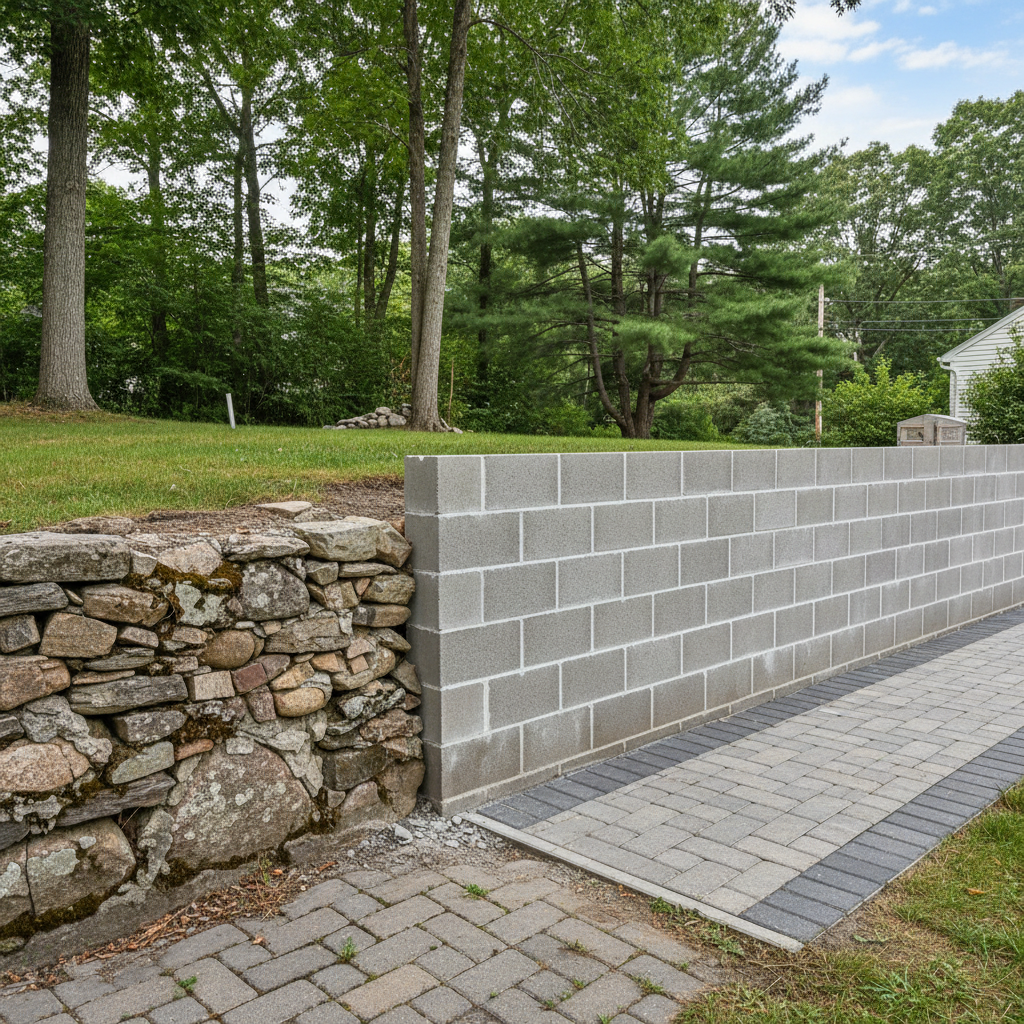
Alright, Needham homeowners, let's talk walls. Whether you're looking to hold back a slope, create a raised garden bed, or build a sturdy foundation for an addition, you're probably weighing your options for block construction. Two of the most common approaches I see folks consider are traditional Concrete Masonry Unit (CMU) block walls and what we call Segmental Retaining Walls (SRW). They both do the job, but they do it very differently. Let's break down what you need to know.
CMU Block Walls: The Old Reliable
When I say CMU block, think of those standard gray concrete blocks, usually 8x8x16 inches, laid with mortar. This is the classic, time-tested way to build a strong, rigid wall. We've been building with these for ages, and for good reason.
Durability & Strength
CMU walls are incredibly strong, especially when reinforced with rebar and filled with concrete. They're designed to handle significant loads and pressures. If you're building a structural foundation wall, a basement wall, or a really tall retaining wall that needs to hold back a lot of earth, CMU is often the go-to. They're built to be rigid and unyielding, which is exactly what you want in many structural applications.
Appearance & Finish
On their own, CMU blocks aren't exactly beautiful. They're utilitarian. But that's where the finish comes in. You can stucco them, apply a stone veneer, or even brick face them. This flexibility means you can achieve almost any aesthetic you want, matching your existing home or creating something entirely new. The finished look can be seamless and sophisticated.
Cost & Installation
Generally, CMU walls tend to be more labor-intensive to install. You're dealing with mortar, rebar, concrete pours, and often a separate finishing step. This can drive up the initial cost. They also require a solid, deep footing below the frost line, which is crucial here in New England with our freeze-thaw cycles. Digging that deep footing adds to the excavation and material costs.
Maintenance
Once built and properly finished, CMU walls are pretty low maintenance. You might need to re-point mortar joints after many decades, or repair a crack in the stucco or veneer if it gets damaged. But overall, they're built to last with minimal fuss.
Segmental Retaining Walls: The Modern Landscape Solution
Segmental Retaining Walls are different. These are interlocking concrete blocks, often with a textured face, that are dry-stacked without mortar. They rely on their weight, interlock, and often a geogrid reinforcement system to hold back soil.
Durability & Strength
SRWs are excellent for landscaping applications – garden walls, terracing, decorative retaining walls up to a certain height. They're designed to be flexible, meaning they can tolerate minor ground movement without cracking, unlike a rigid CMU wall. For most residential landscape needs, they're plenty strong. However, for very tall walls or walls supporting heavy structural loads, CMU is usually the better, more engineered choice.
Appearance & Finish
This is where SRWs really shine for many homeowners. They come in a huge variety of colors, textures, and styles – tumbled, split-face, natural stone look. You pick the block you like, and that's your finished look. No need for additional veneers or stucco. They often blend beautifully into a landscape design, offering a more natural, less 'built' appearance than a finished CMU wall.
Cost & Installation
Installation for SRWs is generally quicker and can be less expensive than CMU, especially for shorter walls. There's no mortar, no rebar (unless specified for taller walls), and often no need for a deep concrete footing – a compacted gravel base is usually sufficient. This saves on labor and material costs. However, for taller walls, the amount of excavation for the base and the need for geogrid can add up.
Maintenance
SRWs are also low maintenance. Because they're dry-stacked, you won't have mortar joints to worry about. If a block gets damaged, it's often easier to remove and replace a single unit. You might need to occasionally clear weeds from between the blocks, but that's about it.
So, Which One's Right for Your Needham Yard?
Here's the deal: there's no single