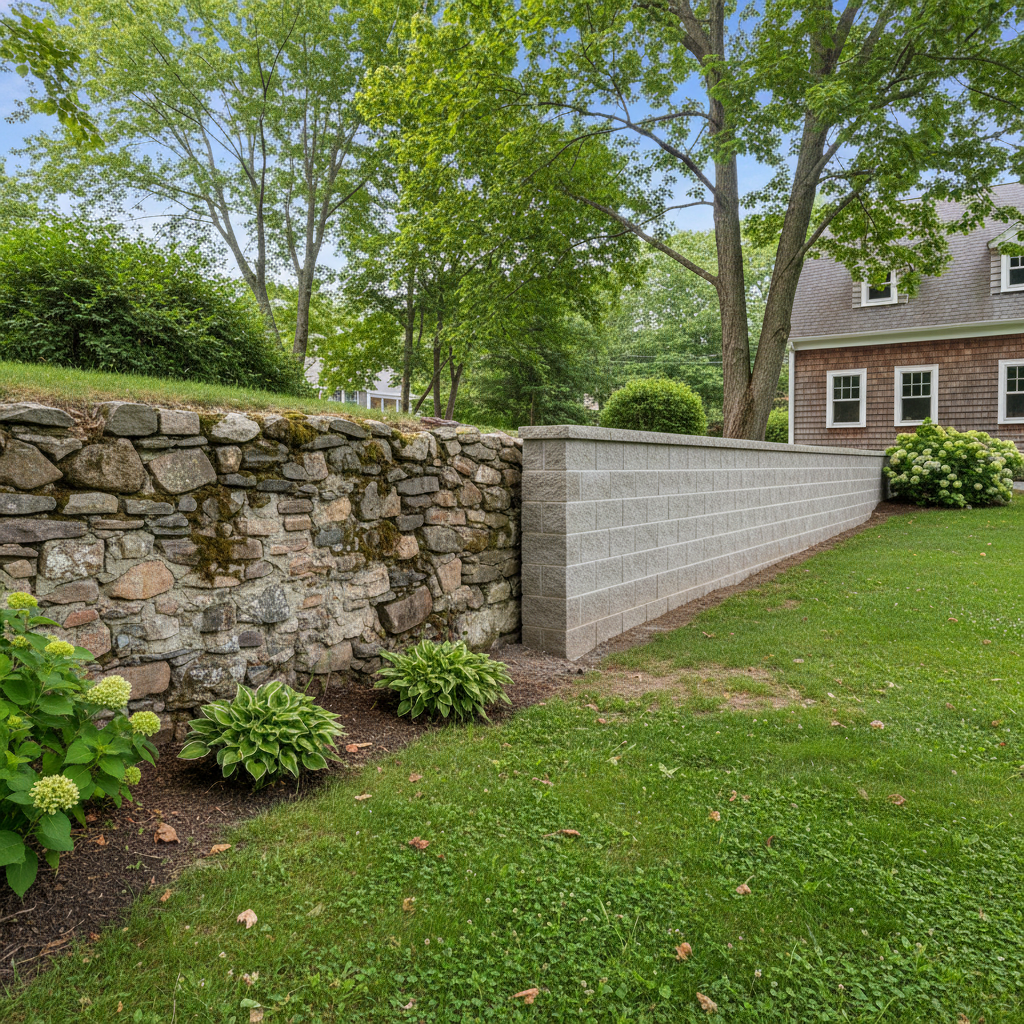
You're thinking about a new retaining wall, a foundation for an addition, or maybe a sturdy garden border. Great idea – a well-built block wall can add a ton of value and function to your property. But when you start looking into it, you'll quickly realize there are a couple of main ways to get the job done. For homeowners here in Needham, it usually comes down to two big contenders: the classic mortared concrete masonry unit (CMU) wall or the increasingly popular dry-stacked segmental retaining wall (SRW) system.
I've built plenty of both around town, from Broadmeadow to Bird's Hill, and each has its place. Let's talk about what you really need to know.
Mortared CMU Walls: The Old Reliable
When I say 'mortared CMU wall,' I'm talking about your standard concrete blocks laid with mortar joints, just like building a brick wall. Think of a typical basement foundation or a really solid, traditional retaining wall. These blocks are usually 8x8x16 inches, but you can find different sizes.
Cost
Upfront, a mortared CMU wall can sometimes be a bit more expensive than a segmental wall, especially if it's a complex design. The labor involved in mixing and applying mortar, ensuring level courses, and the curing time can add to the overall project cost. Plus, you're paying for the mortar itself.
Durability & Strength
This is where CMUs really shine. When built correctly with proper footings and reinforced with rebar and grout, a mortared CMU wall is incredibly strong and rigid. It's basically a solid, monolithic structure. It can handle significant lateral pressure, which is crucial for taller retaining walls or foundation walls. They're not going anywhere. They stand up to our New England freeze-thaw cycles really well, as long as the drainage behind the wall is good.
Maintenance
Maintenance is pretty minimal. You might see some efflorescence (those white powdery stains) on the surface over time, which can be cleaned. The main thing to watch for is cracking in the mortar joints. If you get a severe crack, it'll need tuckpointing to prevent water intrusion. But generally, they're very low-fuss once they're up.
Appearance
A mortared CMU wall has a very utilitarian, industrial look unless it's finished. You'll often see them stuccoed, veneered with stone or brick, or painted. If you're going for a clean, modern aesthetic and plan to finish it, it's a great blank canvas. If you leave the blocks exposed, it's a very specific look that not everyone loves for a visible garden wall.
Dry-Stacked Segmental Retaining Walls (SRW): The Modern Choice
Segmental walls are made up of individual concrete units that interlock or have pins that connect them. They're 'dry-stacked' because they don't use mortar between the blocks, relying on gravity, friction, and the interlocking mechanism to hold them together. They also typically incorporate geogrid reinforcement for taller walls.
Cost
For many landscaping applications, SRWs can be more cost-effective. The installation process is often quicker because there's no mortar to mix or cure. The blocks themselves might be a bit pricier per unit than basic CMUs, but the reduced labor can offset that, especially for shorter, simpler walls.
Durability & Strength
SRWs are designed to be flexible. This flexibility is actually a strength in our climate. Instead of cracking under pressure from frost heave or soil movement, they can shift slightly without failing. For retaining walls up to a certain height, and with proper geogrid reinforcement, they are extremely durable and effective. However, they aren't typically used for foundation walls where you need a rigid, load-bearing structure for a house.
Maintenance
Very low maintenance. Since there's no mortar, you don't have to worry about mortar joint failure. You might need to occasionally clear debris from between the blocks, and if a block gets damaged, it's usually easier to replace an individual unit than to repair a mortared wall.
Appearance
This is where SRWs really shine for aesthetic appeal. They come in a huge variety of colors, textures, and shapes – split-face, tumbled, natural stone look. You can create curves, steps, and intricate designs that are much harder and more expensive to achieve with mortared blocks. They offer a much more finished and decorative look right out of the gate.
My Take for Needham Homeowners
So, which one's right for you?
For a foundation wall, a basement wall, or a very tall, heavily loaded retaining wall (over 6-8 feet) where rigidity and maximum strength are paramount: You're almost certainly going to want a properly engineered, reinforced, and mortared CMU wall. Or even poured concrete. These are structural elements that need that unyielding strength.
For most landscaping retaining walls (under 6-8 feet), garden walls, terracing, or decorative features: Segmental retaining walls are usually the way to go. They're beautiful, durable, and their flexibility is a real asset against our New England soil movement and frost. Plus, the range of aesthetic options is fantastic for blending with your home and yard.
Here in Needham, especially with some of the older homes and varying soil conditions – from sandy loam to areas with more clay – the flexibility of SRWs can be a big advantage for landscape walls. They handle the seasonal expansion and contraction of the ground better than a rigid, unreinforced mortared wall might. But if you're building something that needs to hold up a house, don't skimp on the strength of a good old mortared CMU or poured concrete.
Ultimately, it comes down to the specific application, your budget, and the look you're going for. Don't hesitate to give All Star Masonry a call. We can walk your property, talk through your project, and help you figure out the best block wall solution for your home.